- Home
- Explore
- Town History
- Early 1970s-Late 1990s
Early 1970s-Late 1990s
 Black Civic Leaders
Tax records from the early part of the 20th century show a citizenry evenly divided between the races, but by the 1960s that had changed, and Black residents comprised the majority of the Town’s population. James Norris and William Bernice Lassiter became the first Black commissioners in 1973, with Mr. Norris going on to become the first Black mayor in 1980. Nancy Womble and Cora Mae Lassiter became the first Black female commissioners in 1975 and in 1981 Dessie Mae Womble became the first Black female police chief in the state, beating out 25 other applicants for the job.
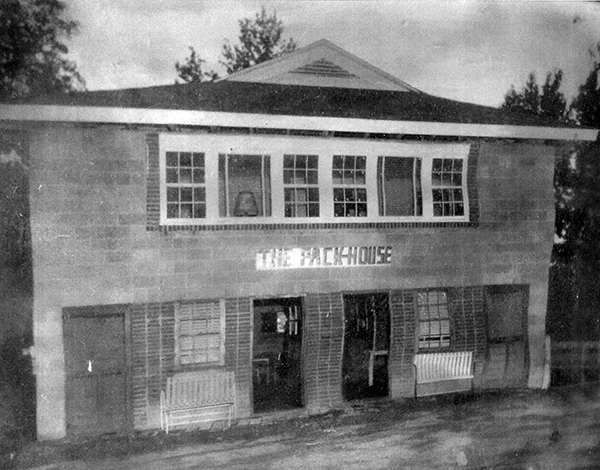
Black-owned businesses thrived. Willis Jones operated a photo shop on Grigsby Avenue, developing pictures for the community. Green Prince ran a grocery store and delivered ice from house to house. George Grigsby operated the Pack House, which operated as a convenience store, with a dance floor and, later, a pool hall. Lattie Rogers ran a blacksmith shop as late as the 1950s, fixing wagons and plows and shoeing horses and mules.
Black History Tour
The Town's mobile, interactive Black History Tour gives users a glimpse into the rich history of Holly Springs. Use your phone to navigate as you walk downtown, see historical photos, and hear residents' recollections. For the navigation features on a phone, use the Google app or any web browser other than Safari. Rather than walk it, you can also scroll through the tour on your computer. Click here to start the tour!
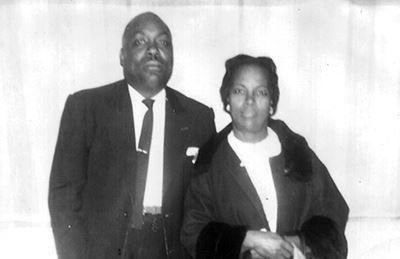 William Bernice Lassiter and James Norris
Lassiter and Norris were elected as the Town’s first Black commissioners during the 1970s. Norris became the first Black mayor of Holly Springs when he resigned as commissioner in 1980 to fill the vacated mayoral seat. Pictured are William Bernice and Cora Mae (Norris) Lassiter, who was appointed to the Town Council in 1981 to fill a vacated seat. In the group image, James Norris is second from the left.
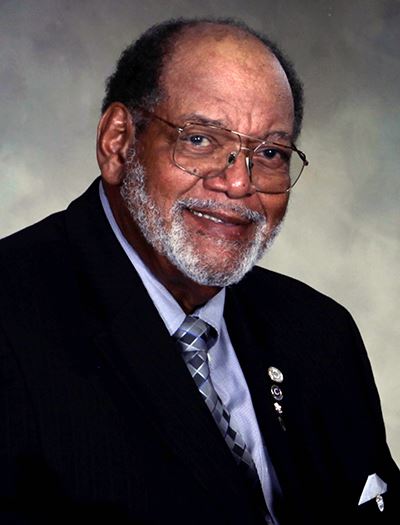 Parrish “Ham” Womble
Womble served nearly three decades as a Holly Springs town board member and for a year as mayor.
Holly Springs was a community of a few hundred residents when Womble joined the town Board of Commissioners in 1981. He served for the next 20 years. In January 2001, the board appointed him as mayor when Gerald Holleman resigned. Womble lost the mayoral election that November but returned as a board member two years afterward and served until 2011.
By 1997, Holly Springs was beginning to build a town parks system, almost from scratch. What is now Hunt Recreation Center was then a former school building serving as a Town Hall annex. Across from the Hunt Center were tobacco fields that appeared slated for subdivision expansion. Womble advocated for buying the 46-acre tract for park land instead. What today is Parrish Womble Park has ball fields, tennis courts, synthetic turf soccer and lacrosse fields, a volleyball court, picnic shelter, and more.
Womble also was instrumental in securing land for Holly Ridge Middle and Elementary schools.
In his professional life, Womble served with the Wake County Sheriff’s Department. He retired with the rank of major in November 1997.
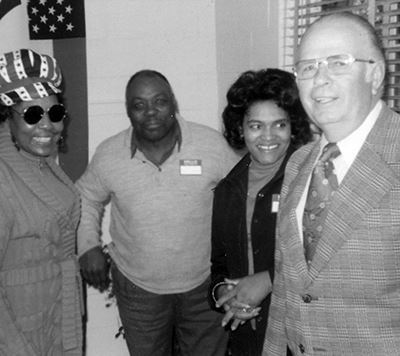 Nancy Womble
Womble was the first Black female to be elected to serve on the Holly Springs Board of Commissioners. She served from 1975-1977. This photograph shows Womble (second from right) at a reception for candidates running for office. Also pictured are Elizabeth Cofield, Bernice Lassiter and Vasser Sherrill.
 Dessie Mae Womble
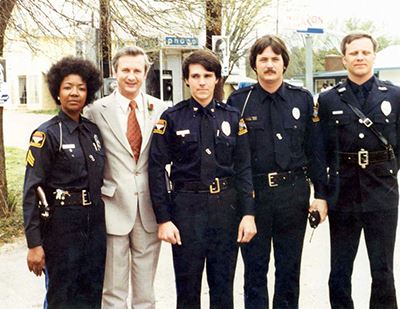
In January, 1981, Jet magazine featured Dessie Mae Womble as the first Black female police chief in North Carolina.
From Jet:
“Womble beat out 25 other applicants for the position, making her the only Black and full-time employee of the small town (approx. 969) and the highest paid at $10,000 yearly.
“‘It feels wonderful, just great,’ says Womble, even though the job is pressure-packed. ‘I really wanted the job and I was qualified.’”
 Otis Byrd
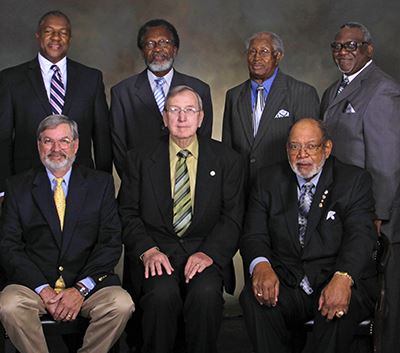
In addition to serving on the Holly Springs Board of Commissioners, Byrd was a Board of Adjustment member. He pastored the First Baptist Church of Holly Springs for more than 24 years and served as assistant precinct judge during elections. In the photograph, he is at the far right in the back row.
Others who served on the Town governing body include: Alfred Beckwith, Willie A. Jones, George Kimble, Cora Mae Lassiter, Ken Martin, John McNeil, Edison Perkins, Floyd Turner.
 William Earl Hunt
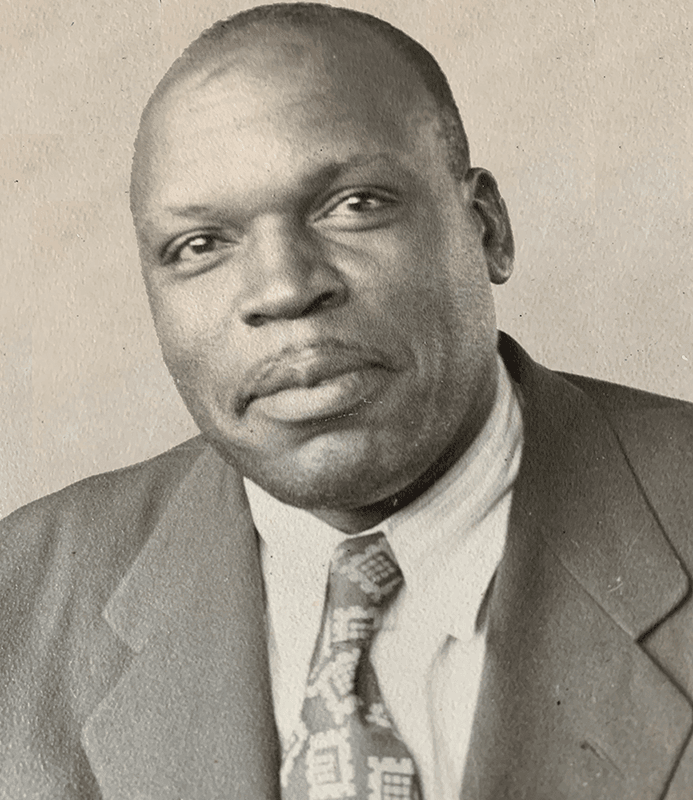
Hunt was a teacher and principal at a school for Black children that stood on the site of the Town recreation center that bears his name. Holly Springs Elementary School opened around 1924. The original plank structure was a Rosenwald School.
Hunt was named principal in 1945 and served for 14 years in the plank structure and in the brick classroom building that replaced it in the 1950s.
Hunt was beloved and respected for his commitment to students and to the community. For a time, he rented a room nearby during the week and commuted home to Raleigh on weekends.
Hunt demanded much of his students and held them to high standards. He established the first Boy Scout troop in Holly Springs and started the 4-H Club, according to newspaper accounts.
After the Town purchased the former school for use as a community center in the mid-1990s, community members asked Town leaders to name the center for the beloved former principal and community leader.